
In the world of fluid handling, the challenge has always been how to move sensitive, abrasive, or highly pure liquids without damaging the fluid or the machine. The peristaltic pump has long been the gold standard for this task. However, as industrial demands for precision and durability have evolved, innovations like the Pulsarm have emerged to refine the traditional mechanics of the pumping process.
Understanding the Peristaltic Pump
A peristaltic pump, often called a roller pump, operates on the principle of positive displacement. Its design is elegantly simple: a flexible tube is fitted inside a circular pump casing. A rotor with a number of “rollers” or “shoes” compresses the tube as it turns.
The magic of this system lies in its containment. Because the fluid stays entirely within the flexible tubing, it never touches the pump’s internal moving parts. This offers three distinct advantages:
1. Contamination-Free: Ideal for medical (dialysis) or food-grade applications.
2. Corrosion Resistance: Since the fluid only contacts the tube, you only need to ensure the tubing material is chemically compatible.
3. Self-Priming: The vacuum created by the tube returning to its natural shape allows the pump to draw fluids automatically.
The Evolution: What is Pulsarm?
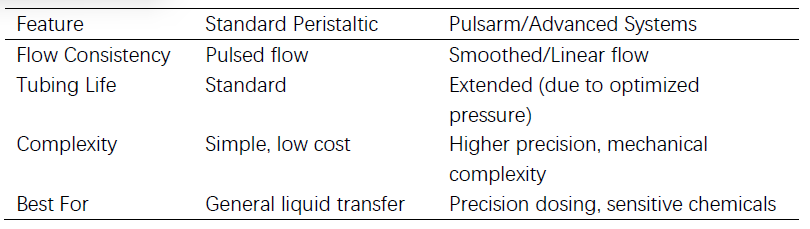
While traditional peristaltic pumps are highly effective, they face a specific engineering hurdle: pulsation. As the rollers release the tube, there is a momentary drop in pressure, resulting in a “pulsing” flow rather than a perfectly smooth stream. Additionally, the constant friction of rollers can lead to premature tube wear.
Pulsarm represents a specialized advancement in pump technology designed to mitigate these issues. While the term is often associated with specific high-performance brands or patented arm-and-linkage designs, the core philosophy of a Pulsarm-style system is to optimize the “occlusion” (the squeeze) of the tube.
Key Features of Pulsarm Technology:
Adjustable Occlusion: Unlike fixed-roller pumps, Pulsarm mechanisms often allow for “spring-loaded” or adjustable arms. This ensures the tube is squeezed just enough to move fluid without unnecessary crushing, significantly extending the life of the tubing.
Pulsation Dampening: Through precision-engineered arm geometry, these systems attempt to smooth out the flow, making them suitable for applications where a steady, non-fluctuating delivery is critical, such as chemical dosing or laboratory analysis.
Reduced Maintenance: By optimizing the contact pressure between the arm and the tube, the mechanical stress on the motor and the tubing is minimized.
Applications and Comparison
Both standard peristaltic pumps and Pulsarm-enhanced systems are used where accuracy and hygiene are non-negotiable.
Conclusion
The peristaltic pump remains a cornerstone of modern fluid dynamics because it mimics a natural biological process—peristalsis—to move material safely. The introduction of the Pulsarm mechanism takes this biological inspiration and applies high-level mechanical engineering to solve the problems of wear and flow fluctuation. Whether it is a life-saving medical device or a heavy-duty industrial chemical feeder, these pumps prove that sometimes the best way to handle a fluid is to never touch it at all.